
Copacabana: The Great American Supperclub
The Copacabana in New York City was one of the most iconic nightclubs of all time.
It was 5:00 AM. Jerry Lewis just walked into Reubens on Madison & 59th St., his arms filled with the early edition of the NY Mirror and his hat turned backward, portraying the hapless paperboy.
He proceeds to sell them table-by-table. He then returned the unsold papers and any money collected to an excited paperboy. On this night, as on most nights, the crowd was a who’s who of the New York City nightclub circuit as remembered & told to me by Harriet Wright. “Sometimes they were there to enjoy the camaraderie, the famous Apple Pancakes, or just to unwind after another night on the town, but it was always a roaring good time,” she said.
The year was 1940, and America had just awakened from a ten-year hangover, better known as the Great Depression. Europe was at war, but the American café society elite wanted to party. The supper club was now the nightlife entertainment of choice (there were no televisions), the successor to the prohibition speakeasies. Hollywood stars like Errol Flynn would frequent NYC clubs like the El Morocco, Stork Club, the Rainbow Room, or “21” – “New York was where the rich and famous came to play”.

On November 10, 1940, Monte Proser opened a new club called the Copacabana. Walter Winchell had referred to it as the “latest click at 10 East 60th Street”. The club became the number one hot spot among a diverse hybrid crowd of sports figures, stars of stage & screen, jockeys, prizefighters, oil barons, gangsters, politicians, columnists, Wall Street, and 7th Ave. executives—a place where moguls would all mix – shaken not stirred. “Every night was New Year’s Eve,” Harriet noted.
The Copacabana was Brazilian in theme, run by Jews and Italians which oddly enough was known for some of the best Chinese cuisines in the city, talk about your melting pot – but that’s New York.
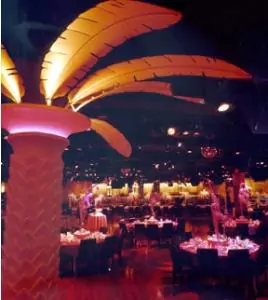
The décor was marvelous art deco throughout, and the main room downstairs was grand with palm trees everywhere illuminated by blue and pink hues. Everyone who worked there was dressed in tuxedos, it was pure elegance – even the bar stools were covered in velvet.
Maitre D’s Joe Lopez, Gus, or Arthur Brown accommodated the guests to the best of their ability, but you needed a reservation. Unless, of course, you were a celebrity or a friend carrying a $100 bill. Some nights, the Maitre D’s would earn $1,000 in tips.
Dress to Impress
There was one rule that everyone—celebrity or not—had to follow: obey the dress code (no jeans, ever) and look the part. Elegance wasn’t just encouraged, it was expected. Gentlemen donned their finest suits, while ladies shimmered in evening gowns, ready to sway to the best live music in town. The velvet-roped entrance and the sharp-eyed doormen made certain that only those who fit the scene made it past the threshold, ensuring that every night inside felt like the city’s most exclusive affair.
With headline entertainment, the Copa was the first supper club to present a line of dancing beauties. Two society and two Latin bands played the hottest Rumba, Merengue, and cha-cha rhythms.
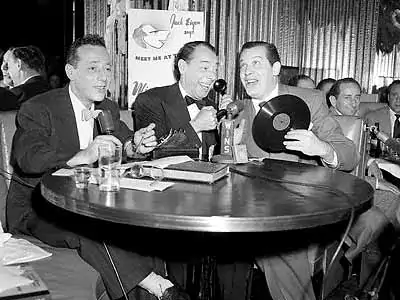
But if you wanted a softer, laid-back atmosphere, you could always stop into the upstairs lounge. Celebrities’ names were called out as they entered by the on-air radio commentator who invited them over to chat with the radio audience at home. When Jack Eigan retired, Barry Gray took over the radio show that aired from 10 PM – 4 AM on WMGM.
A Night at the Copa: Music and Passion in Every Corner
The Copa was always alive with music and passion—long before Barry Manilow ever crooned about it. Swinging the night away was practically a requirement, as guests moved to the pulse of merengue, salsa, and the ever-stylish cha-cha beneath palm trees illuminated in blue and pink. The scene was electric: a dazzling dance floor, disco balls spinning overhead (yes, even in the early days), and a crowd that knew how to let loose.
The vast main room, sometimes dubbed the Carmen Miranda Room, was where pros and novices alike could be found—shoulder-rolling, hip-shaking, and loving every minute. Whether you were a seasoned dancer or just along for the ride, the infectious rhythms ensured you wouldn’t be sitting long.
Downstairs, for those seeking a more modern beat, DJs spun the latest hip-hop and dance tracks, while upstairs remained a haven for those craving that classic supper club vibe. And if you timed it right, weeknight happy hours sometimes featured a buffet to fuel your next round on the dance floor.
There was a place at the Copa for every mood: glittering spectacle and high-energy movement in the main room, sultry Latin vibes drifting from the bands, or a quiet moment in the lounge with the city’s elite. Each night was a celebration—where music, elegance, and a dash of New York attitude were always in fashion.
If Ziegfield glorified the 20th-century woman in the 1920s and ’30s, Monte Proser glorified the “great American super-club”. Managed by Jack Entratter with the help of Jules Podell, the mob’s man in charge, the Copacabana was on its way to becoming the stuff that legends are made of.
Columnists and celebrities collaborated in an unspoken ritual of career enhancement, and the Copa was the beneficiary. Mob bosses such as Albert Anastasia and Frank Costello were never written about, nor was their friendship with Jack Entratter. One slip-up and a columnist could find themselves on the black list. Cameras were not allowed inside either. A patron could get a picture taken by a concession photographer, who had to ensure no one was in the background. Jules Podell controlled the club with an iron fist and was famous for pounding his diamond ring on any hard surface – he was all business.

Almost overnight, the Copa became the crossroads for Hollywood, Europe, and New York City. In the Broadway column of the Gotham Gazette, Danton Walker wrote, “The storytellers of Hollywood: screenwriters Jesse Lasky Jr., Richard Brooks, and David Lord in town to make studio war training films, were sitting ringside at the Copacabana. Was the stage attraction pretty dancer Harriet Weber (Wright) the reason David Lord plans to see a preacher?”
The dancers were known as ponies for their short stature, ranging from five feet to five foot four inches tall. Walter Winchell said, “It’s the best girl show in town”.
They were beautiful and dressed in extravagant outfits costing as much as $4000 each. In 1940, that was a lot of cash, baby; the girls earned $75.00 per week, while the average working man earned $40 per week. You could buy a Beef Stroganoff meal at the Copa for $7.95 and a drink for $1.70 back then.
The atmosphere was as lively as you’d expect—friendly, with staff quick to offer a tip if you tried to cut a rug and needed a little help with your fox trot. There was even a complimentary buffet (not half bad, either), so you could fuel up between dances and spectacles. Thursdays opened the doors to ladies 18 and up, but come Saturday, you had to be 21 to join the fun. Drinks might have been a splurge—think $12 for a Long Island these days—but just as then, the pours were generous and the spirits high.

Walter Winchell said, “Paying customers who came back with endearing regularity were impressed by the Copacabana girls.” And Dorothy Kilgallen wrote, “among those watching were Billy Rose and Eleanor Holm, who could hardly take their eyes off the pretty line of girls. Was Billy scouting for his next show? Harriet Weber (Wright), a protégé of his World’s Fair Aquacade, was a front-line stunner.”
The girls wore mink bras and panties and dyed their hair to match the colors of their outfits, which were changed every three months. They performed three shows nightly and sometimes the crowd was so large they all but tripped over the tables that were just barely set back from the dancing area. The seating was always referred to as “flexible” and could balloon from 670 to 1500 on any given Saturday night.
The club itself thrived on spectacle and scale. Since its relocation, the Copa could easily accommodate a crowd of up to 4,000, and by 6:30 pm on Tuesday evenings—the only weeknight it opened its doors—hundreds would line up outside, eager for the weekly after-work party. On those nights, the energy was electric, the space packed with Latin hip-swingers, fast-footed regulars, and anyone hoping for a brush with the city’s glittering nightlife.
The girls were not allowed to mix with the customers so they would sneak off many times between shows to meet dinner dates, which was against the rules. Harriet had told me “Just picture four dancers changing in the back seat of a cab to and from the dinner date to the amusement of the driver.” Harriet wasn’t just “a” Copy girl, she was one of “the” Copa girls, finding herself in the headlines from time to time:
It seemed that everyone loved to be seen with the Copa girls
- Columnist Dorothy Kilgallen, The Voice Of Broadway wrote “was the president’s son John Roosevelt eyeing Harriet Weber and sending Orchids backstage to her at the Copa”?
- Walter Winchell noted spotting “Jimmy Durante and Harriet Weber, a front line pony partying after the show.”
- Louis Sobel of the New York Cavalade said that “Ted Howard reported seeing Copabeaut, the lovely Harriet Weber at Ruebens with Sam Bramson of the Wm. Morris Agency.”
- Even Ed Sullivan wrote in Little Old New York “Is Harry Ritz of the famous Ritz Brothers carrying on a 4-alarm blaze with Harriet Weber – Copacabana cutie?”
But the Copa was not for tourists. They were drawn to the Latin Quarter or the Diamond Horseshoe. They had a big list of other clubs to choose from as well, including The Village Gate, Beverly Room, Glen Island Casino, International Casino, Tony Paster’s Uptown, Hawaii Kai, Living Room, Carnival, Metropole, China Club, Empire Room, Leon & Eddies, Sardi’s, Jilly’s, Zanzibar, Riviera, Ed Wynn’s, 81 Club, Chez Vito, Onyx Club, Peppermint Lounge (famous for the twist), Byline Room, Basin Street East, Jack Dempsey’s, Hawaiian Room, Greenwich Village Inn, Billy Reed’s Little Club, Club 82 (had some of the best and grandest Drag Queens of the day parting here), Gilded Cage, Persian Room, Chateau Madrid, La Conga, Round Table, Lindy’s, Birdland, Cotton Club, The Blue Note, Bon Soir, Brassierre, Cotillion, Blue Angel, Jazz Spots on 52nd St., Downstairs @ the Upstairs, Julius Monk’s, At the Round Table, King Arthur’s Room, Goldies on Lex and the Pin Up Room. You get the idea — there were A LOT of clubs to choose from.
The Copacabana was a celebrity-driven superclub.
“If you had a successful run at the Copa you were almost guaranteed stardom”, Harriet Wright wrote in her memoir “I’d Do It Again.” Below is a list of some of those stars:
“Frank Sinatra, Lewis and Martin, Sammie Davis Jr., Nat King Cole, Peggy Lee, Jimmy Durante, Johnny Mathis, Della Reese, Mel Torme, Steve Lawrence, Edie Gorme, Jerry Vale, Lucille Ball, Desi Arnaz, Pattie Page, Kay Thompson & the Williams Brothers, Bobby Rydell, Donald O’Connor, Tom Jones, Bobby Darin, The Temptations, Diana Ross & The Supremes, Connie Francis, Connie Russell, and Joey Bishop
However, Harriet said, “Remember that this is the 1940s and 50s, so while superstars like Nat King Cole and Sammy Davis Jr. performed at the Copa as well, in those days they still had to enter through the back door”. Young people who came of age in the 60s and 70s were ignorant of barriers and color privilege before the civil rights movements of the 60s.
I had the privilege and pure delight of sitting down to talk with Harriet Weber Wright (who went on to swim in Ester Williams movies), as well as Dorothy Gurry (who was in the last line at the Copa in 1969). Paula La Mont, (the daughter of a Ziegfield Follies Girl – and the current president of the Ziegfield Girls Club) who was a Copa girl throughout the late 1950s and into the early ’60s, and Myrna Lee, another Copa girl (who is still a nightclub singer today).
The Copacabana, whose last line of Girls ran until 1969, closed in 1973, and to this day, it still evokes fond memories of those I spoke to. (Note: John Juliano reopened the Copacabana in early 2002; Harriet was his special guest, and I was hers.)
There is something magical about it that I can’t seem to put my finger on. But it is out there lingering like a dream you remembered when you awoke that has now become slightly fuzzy.
Even after the club closed, the girls remained Icons, and on October 15, 1976, they formed the “World Famous Copacabana Girls Inc., a non-profit organization with 150 Copa girls. They hosted benefits for aids and other charitable events, which were supported by such dignitaries as Mayor Beame, Henny Youngman, Michael Todd, Liz Taylor, Robert Mitchum, fashion designer Clovis Ruffen (Harriet’s son), Nicky Haskell, and Joan Crawford, to name a few. In 1978, seven Copa girls, including Harriet and Paula, danced in costume with Peter Allen at the Waldorf Astoria when he performed his hit song “I Go To Rio.”
The formula for what created the mystique of the Copa was not one secret ingredient – it was all of it: the times, style, sophistication, danger, Copa girls, Jules Podell, live radio, and columnists who loved to report about it all. Even the famous brawl between Mickey Mantle, Roger Maris, Billy Martin, Whitey Ford, and Hank Bauer only enhanced the club’s popularity. It was not just another club – it was an experience.
As I talked to these four women I was overcome with Nostalgia, like a warm breeze of endearing images so close and so real I could almost reach out and wrap my arms around them. With all the talk about these legendary entertainers “did anyone meet Frank Sinatra”? I asked.
Harriet noted, “He threw the best parties in town, always at his suite at the Waldorf Astoria. The only catch was you couldn’t leave until Frank said so. We were the eye candy, so he always ‘requested’ we stay until most of the guests had left. Meet him? Sure, we all met him, and SHE SLEPT WITH HIM.”
I inquired, “So how was it?” Though I got my answer, I was asked to keep that and who the “she” was anonymous.
The Girls of the Copacabana are part of a legacy that will never happen again in quite the same way, and for that, they have memories to cherish and a bond to share. In a future article, they’ll speak candidly about celebrities, lovers, performance mishaps, romance & dating, the nightlife then and now, glamour, and style. It’s a once-upon-a-time story of when they were in the chorus line at the COPACABANA.
This article first appeared in GIRL TALK MAGAZINE
Copyright 2002 – All Rights Reserved. Brie Austin
Tags: Copacabana superclubNYC nightlife
About Brie Austin
Brie Austin is co-author of 'I'd Do It Again', a website content writer, columnist, and reporter. He is a member of the International Federal of Journalists, National Writer Union, and Society of Professional Journalists.7 Comments + Add Comment
Leave a comment
Follow me


Would love to know names of musicians who played at the Copa. Always wondered if my dad was one of the musicians.
Yeah, it was a great era according to the women I interviewed for this articles, one of which was a very dear frined of mine. But I never had any info about the musicians
You state that the club opened on November 10, 1940, but according to an article in The New York Times on November 2, 1940, the club was already open and hosting Pancho’s and Fausto Curbello’s Orchestras as performing. Can you explain the discrepancy?
https://timesmachine.nytimes.com/timesmachine/1940/11/02/112774365.html?pageNumber=18
Not entirely sure, but according to the girls I interviewed, as well as Wikipedia it opened on Nov 10, 1940 https://en.wikipedia.org/wiki/Copacabana_(nightclub). Perhaps nov 2 was a soft opening
Who was Frank Caputo? He worked there for many years, in the 60-70’s era. Does anyone know him?
Hi, I’m not really sure, and my friend Harriet, who was a Copa dancer back into he 1940s passed on years ago, so I don’t have anyone from that era to inquire with any longer.
[…] The original club, founded by Monte Prosner in 1940, was known as the “Great American Supperclub.” […]